
Adopt security with
confidence & accountability.
Four independent practice areas, each mapped back to the COMPASS™ business risk model. Engage one, or run them as a single co-managed program.
Pick the one that is on fire. We will handle the rest later.
Agentic AI Security
Most security programs were designed before autonomous agents could authenticate, call tools and act on your data. We close that gap.
- Secure AI discovery: find the AI already in use, sanctioned or not
- Agent deployment with policy guardrails and blast-radius limits
- AI identity management: non-human identities treated as first-class
- Model protections and AI operations review
- AI GRC plan management, run inside deepcurrent
Infrastructure & Systems
Asset protection across cloud, on-premise and hybrid, including the legacy systems everyone quietly hopes will not come up in the audit.
- Cloud, on-premise and hybrid asset protection
- Legacy system assessment and compensating-control design
- Architecture review and implementation guidance
- Cyber resilience planning and incident recovery design
- Vendor-neutral control solution research
Cyber Security
AI and non-human identity managed as a single risk surface, because an agent's credentials are as exploitable as a person's.
- AI Security access controls and agentic AI identity security services
- Non-human and service identity security
- AI agent identity and delegation controls
- Access governance mapped to your compliance obligations
- Identity risk scored into the COMPASS™ model
Governance & Compliance
Audit readiness that is a by-product of running the program properly, not a fire drill every twelve months.
- ISO 27001, NIST, PCI DSS, SOC 2, HIPAA and CMMC alignment
- One control set scored and mapped across every framework
- Policy and standards drafting and review
- Third-party and supplier risk method
- Scoped, read-only auditor access in deepcurrent
AI does not fail in one place. It fails in the seams.
It fails between the model, the data feeding it, the identity calling it and the person accountable for the answer. The deepwater Framework covers seven domains so nothing important ends up in the gap between two teams who each assumed the other had it.
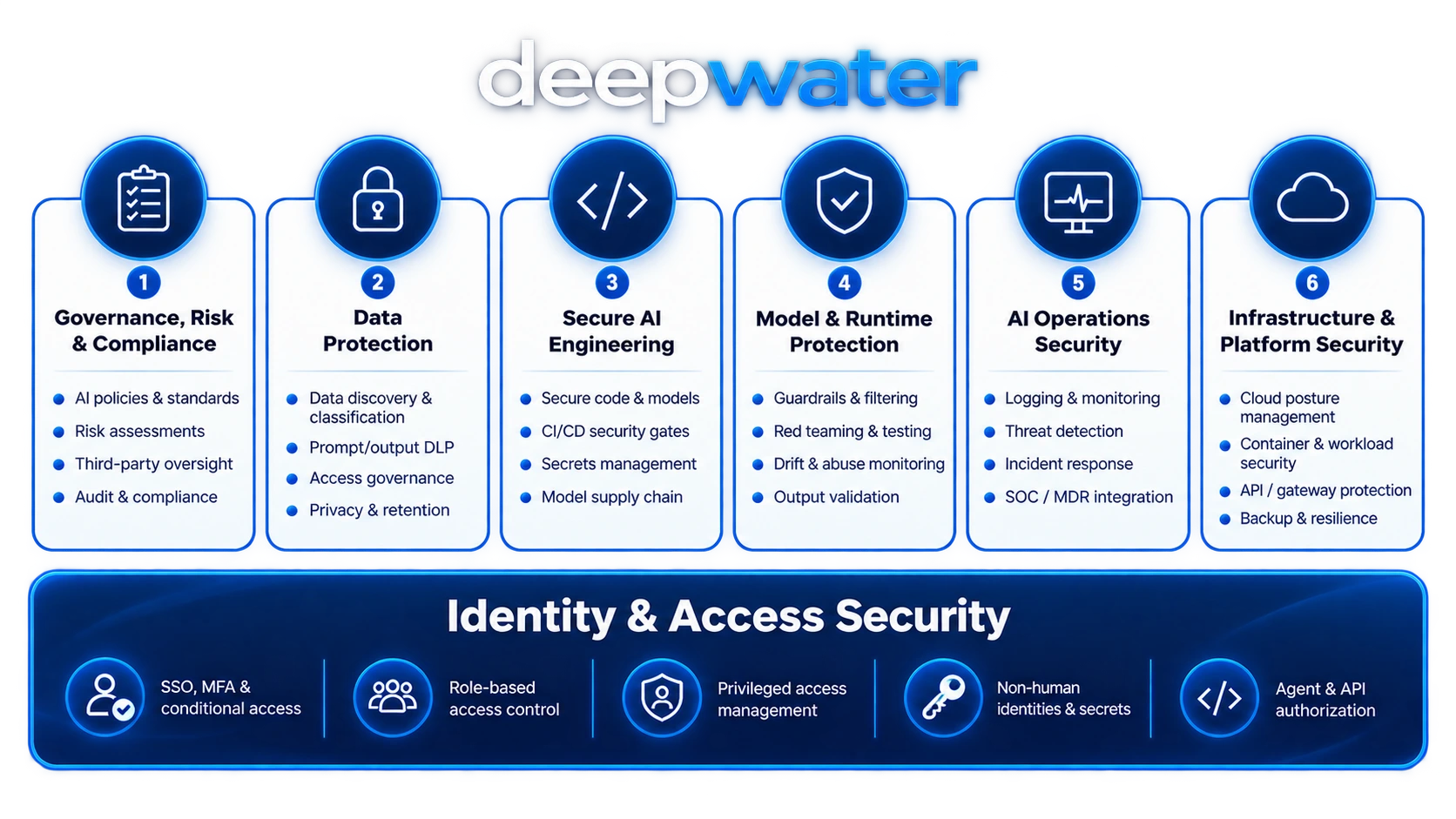
Governance, Risk & Compliance
Who approved this model, against which standard, and can you show that to an auditor? This is where AI decisions get a paper trail, before a regulator or a customer's security team asks for one.
- AI policies and standards
- Risk assessments
- Third-party oversight
- Audit and compliance evidence
Data Protection
The quickest way to lose control of sensitive data is for someone to paste it into a prompt. Classification and prompt-level controls keep your data from leaving through the model itself.
- Data discovery and classification
- Prompt and output DLP
- Access governance
- Privacy and retention
Secure AI Engineering
Models ship like software, so they inherit software's supply chain problem. Gates in the pipeline mean what reaches production is what you actually reviewed.
- Secure code and models
- CI/CD security gates
- Secrets management
- Model supply chain
Model & Runtime Protection
A model that behaved perfectly in testing can be talked into something else by a real user. Guardrails and adversarial testing keep behavior bounded once it is exposed.
- Guardrails and filtering
- Red teaming and testing
- Drift and abuse monitoring
- Output validation
AI Operations Security
When an agent misbehaves at two in the morning, somebody has to see it and know what to do next. AI activity belongs in the same place your team already watches everything else.
- Logging and monitoring
- Threat detection
- Incident response
- SOC and MDR integration
Infrastructure & Platform Security
AI runs on the cloud estate you already have, and it inherits every weakness in it. Nothing here is new work so much as work that now carries more consequence.
- Cloud posture management
- Container and workload security
- API and gateway protection
- Backup and resilience
Identity & Access Security
The other six domains all assume one thing: that you know who is making the request. That assumption is the first to break. Agents, service accounts and API keys now outnumber your people in most environments, and a good share of them were provisioned in a hurry and never reviewed. This is the layer everything else stands on, which is why it runs the full width of the framework instead of sitting alongside the rest.
- SSO, MFA and conditional access
- Role-based access control
- Privileged access management
- Non-human identities and secrets
- Agent and API authorization
How your advisor actually uses it
The framework is a scoring instrument, not a poster. Your Black Bay advisor works through all seven domains against what you have genuinely got running, not against a questionnaire someone filled in optimistically. What comes out is a single AI security strategy and a three-year roadmap: what to fix now because it is exposed today, what to defer because the risk does not yet justify the spend, and what to switch off because something you already pay for covers it.
That ordering is where the cost reduction comes from. Sequenced work is cheaper than parallel panic, and the roadmap usually retires more tools than it adds.
What clients actually bring us.
Secure AI adoption
The business wants agents in production next quarter. We run discovery on what is already deployed, set policy guardrails, and govern the identities those agents use, so the rollout happens on schedule and defensibly.
CMMC readiness
A contract requires alignment you do not currently have. We scope the requirement, score the gap in deepcurrent, and produce a sequenced remediation plan with owners and dates rather than a 200-page report.
Cyber resilience
Recovery planning and incident readiness for the scenario that actually threatens revenue: tested, documented, and mapped to the operational risk domain the board already tracks.
Every recommendation traces back to something the business told us mattered.
The COMPASS Executive Alignment Workshop happens before any technical assessment. It establishes what the executive team is actually protecting: revenue, contracts, reputation, a specific regulatory obligation, and weights everything downstream accordingly.
Brand & Reputation
Hover, tap or arrow onto a segment to explore.
Scoping questions.
Can we engage just one practice area?
Yes: the four areas are independent. Clients commonly start with the one that is under immediate pressure (an AI rollout, a CMMC deadline, a failed audit finding) and widen scope later.
What does "CMMC readiness" involve?
A scoped assessment against the CMMC requirements you are subject to, gap identification inside deepcurrent, and a sequenced remediation roadmap with owners and dates. Confirm current CMMC level coverage with your advisor.
How do you handle AI security differently?
We treat AI systems and agents as identities and as assets simultaneously: they authenticate, they hold permissions, and they act. That means discovery, guardrails, and identity governance rather than a policy PDF.
Do you implement the controls yourselves?
We are advisory and independent. We design, sequence and oversee, and on the Advanced tier provide architecture and implementation guidance, but we do not resell products or take vendor commissions.
Which one is keeping you up?
Bring the specific problem. We will tell you honestly whether it needs a program, a project, or a two-hour conversation.
No cost. No obligation. No vendor pitch. We don't resell anything.